Company
Duration
#
Process
Marvel@DC
I created a context relevant design process, which was adopted, trialed, and evolved as the organisation moved from longer-term planning towards fast OKR driven tactical work which typically was completed within the quarter.
Role: Design Leader, responsible for creating and operationalising the Marvel@DC design process across DataCamp.

Why
Marvel was created from the need to focus on customer experience
The context at DataCamp was that the company needed to improve their focus on customer experience rather than building purely business-requirements-driven products. Equally there was a lack of common ownership of both the problem and solution space with a somewhat top down driven strategy. The final requirement was to have the competitive advantage of being fast.

What is Marvel@DC
Marvel is both a workshopping approach but also a process for delivering work at high speed.
I created the Marvel@DC process for DataCamp, this used 4 key steps and a few critical approaches to create high value fast and with minimum investment of time (Pareto 80/20). I also conceived the concept of ‘test in live’ which was in service of speed and allowed the product organisation to release product fast and validate / evaluate post launch.
High-level 4 steps in the process.
Customer need
Ideation
Build a test
Learn
The process core was build around establishing customer needs by transforming business requirements into customer needs and using affinity mapping and dot voting to ensure a solid strategic focus.

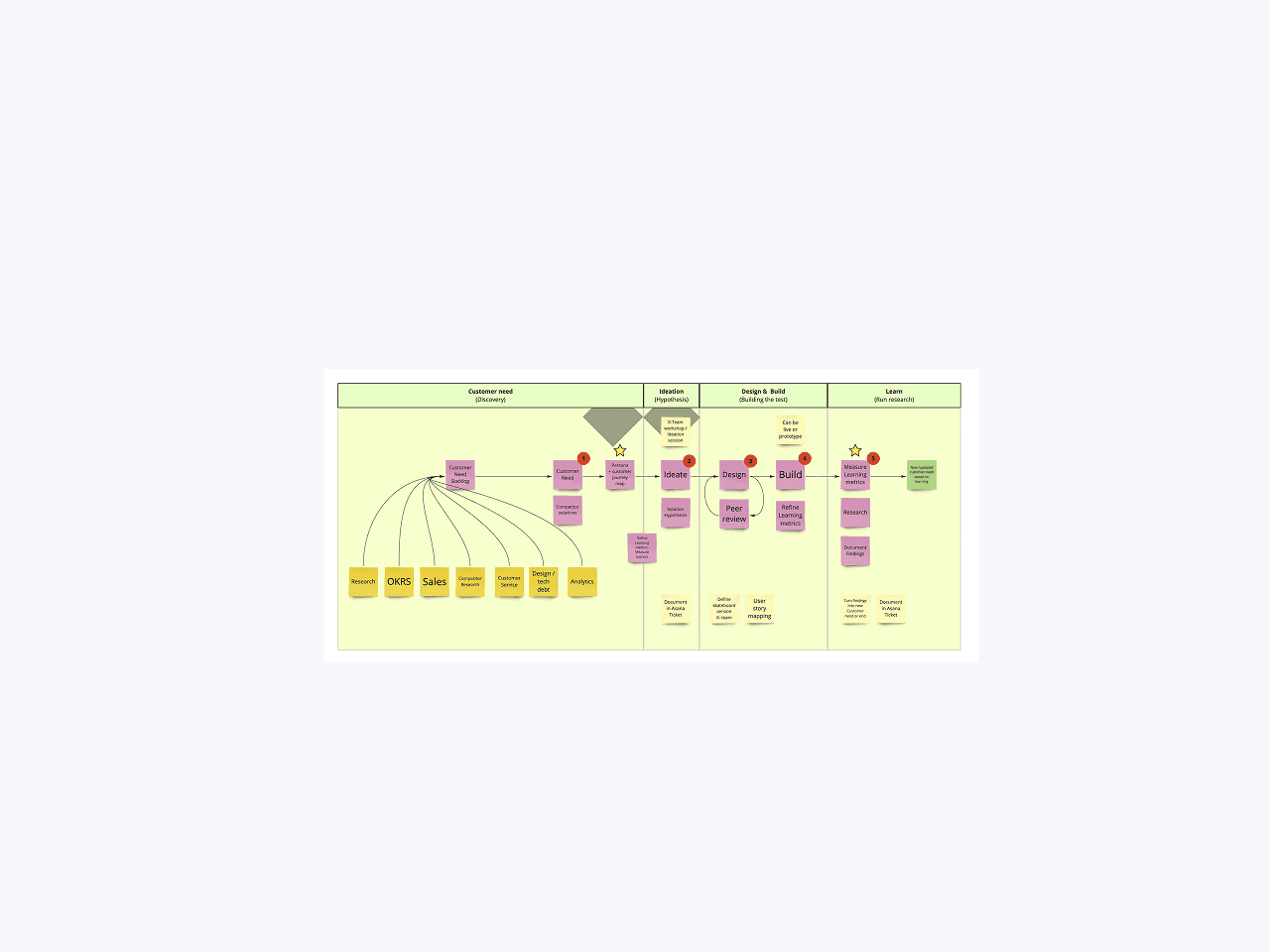



High-level Process
The high-level process was built around the commonly used scientific method, while this is a great idea on paper, depending on the scale of each initiative its not always a good fit.
Detailed Process
We developed the process into more detailed steps including a workshop template. Another important part of the workshopping was to involve the three-headed team of product, design, and engineering. This created consensus on both the problem to solve and potential solutions as well as guidance on technical constraints and business requirements early on in the process.
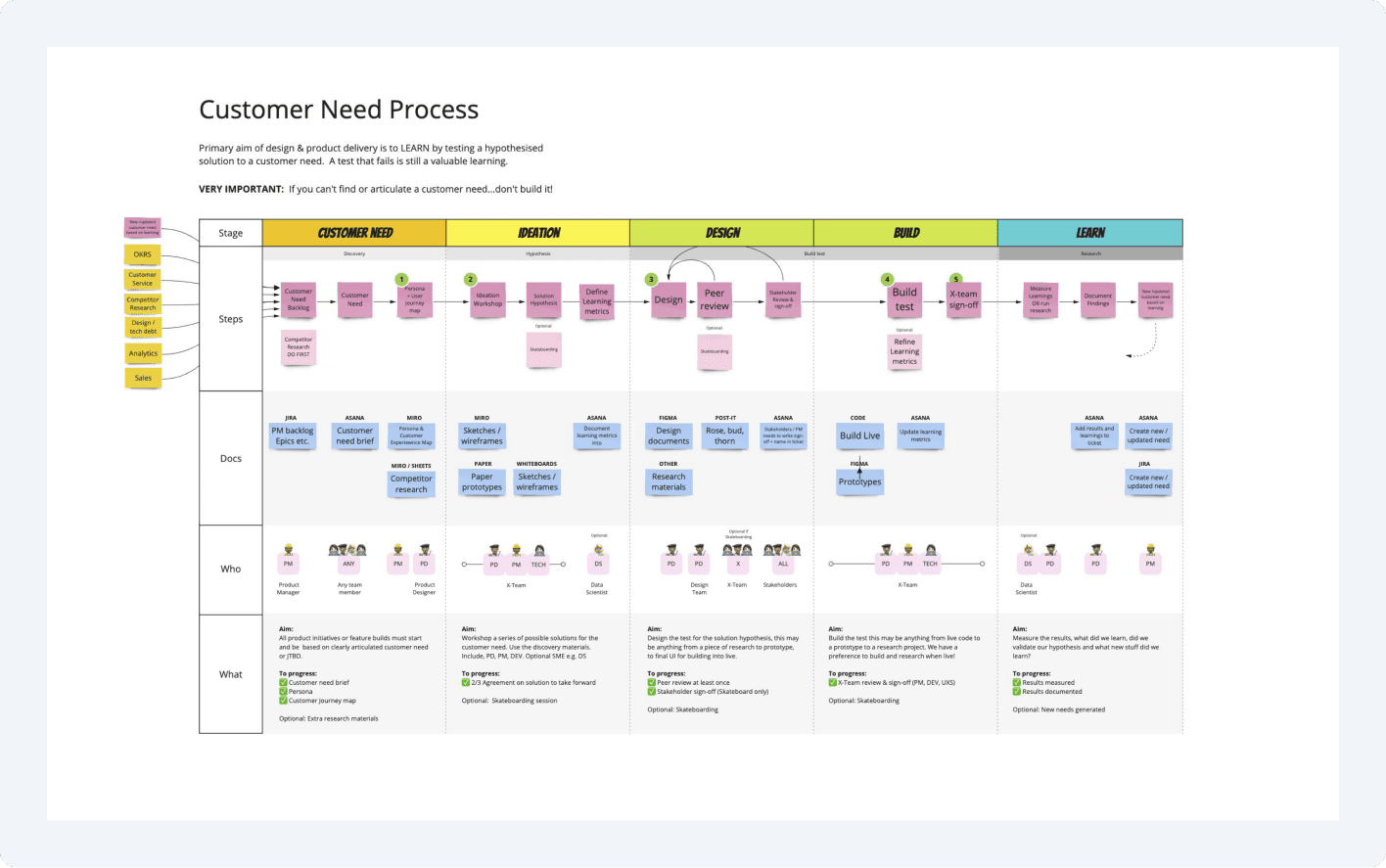
Detailed process flow including inputs, gates, artefacts and participants
Process applicable to small and large scenarios
In order to have a single process, the process was designed to work for both small and large pieces of work. While great on paper the practice was less successful so a more custom approach was used per each piece of work in particular smaller pieces of work might use the fastest solution rather than cut down process to complete the tasks. For medium to larger pieces of work the process was very successful and saved lots of time and money in alignment and baking technical constraints into the ideas early on in the process.
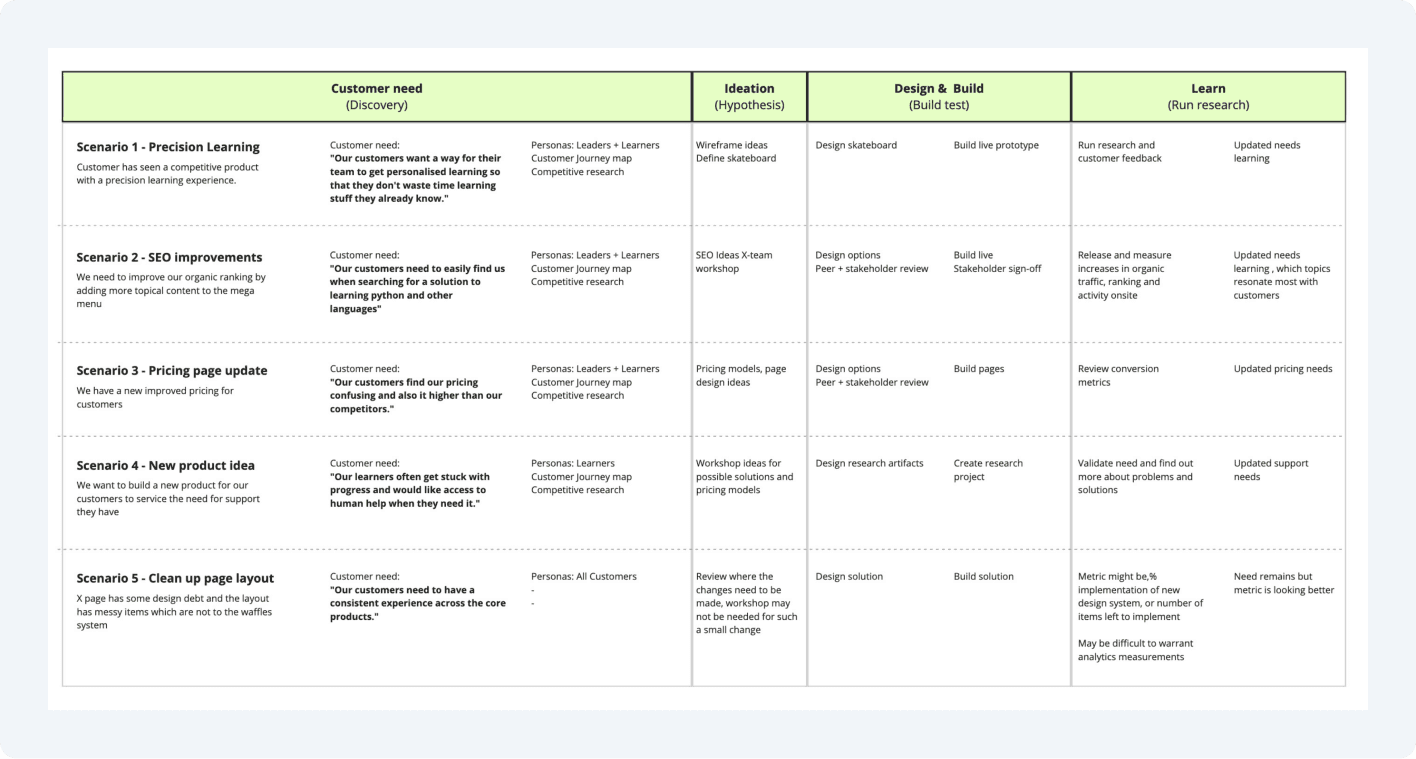
Applying the process to small and large pieces of design work
Summary
The design process was a great success initially with raving reviews from the teams using it due to the speed and time saved. In addition it excelled at building consensus and alignment and x-functional collaboration for projects early on.
Once the business shifted toward more tactical, quick wins, the process was used less often. This led to challenges around scope and alignment, creating wasted time and further reinforcing the value of the process.
DISCOVER MORE